
Finance
Newsletter
Previous Editions
WorldVenture Main Phone Line Goes Live!
You’ve been asking for it for a while now. As of March, donors who call WorldVenture’s main phone number during business hours get a live person who answers their call. So encourage your people to call. They’ll get a member of our Receipting team live, who will be dedicated to answering their questions or resolving their problem.
New Mileage Rate in 2025
The IRS has increased its recommended mileage rate for mileage reimbursement. It is now 70 cents ($0.70). Our Accounts Payable team has already updated our Expense Report forms (both the online one in the GMC and the downloadable Excel version). There are only two things you might need to do. One is to download the latest version of the Excel file, if that is the one you use. The other is to update your Quarterly Work Funds Report file, if you use that form. To do that, go to the rightmost tab in your QWFR file (called “Dropdown box dynamic queries”) and enter the new mileage rate next to the current year in column V.
This newsletter is also published on the GMC for future reference. We know that you have much going on and that keeping up with what is happening in Finance may be another item on a never-ending task list. Thank you in advance for taking some time to read these announcements and for the important work that you do every day. Our hope with sending you this information is not that you become an expert in WV financial matters, but that you are informed of changes that impact you directly, and that you know where to turn if you need help. It is our pleasure to serve alongside you!

Fee Assessment Change Coming.
As you should have heard by now, WorldVenture is revamping the Worker Service Fee starting next fiscal year. The flat fee that has been used for the last 12 years will be abolished, along with all transaction fees. As of July 1, the administrative fee will become a percentage of donation income, as follows:
If you somehow missed the email announcement about this and want more information, let us know. We can re-send you the explanation brochure and FAQ sheet.
Please send us any feedback you have about this newsletter. We want this tool to be as useful to you as possible. Email us at FinanceHelp@worldventure.com.
Soraya Marin – VP/Chief Operations Officer
Fabian Perea – Treasurer
Reda Edelen – Assistant Treasurer
Ryan Volz – Project Manager
Christina Segura – Senior Staff Accountant, Europe/MENA & Americas
Dan Penney – Staff Accountant, Africa & Asia
Kriss Reese – Financial Services Manager
Mary Ackermann – Financial Services Specialist
Becky Binuya – Financial Services Specialist
Renee Chase – Financial Services Specialist
Robin Hall – Financial Services Specialist
You didn’t miss it!
There have been no announcements published in the “Discussions” tab of the GMC by Finance within the last three months, so you can rejoice that you’ve missed nothing (at least from that source).
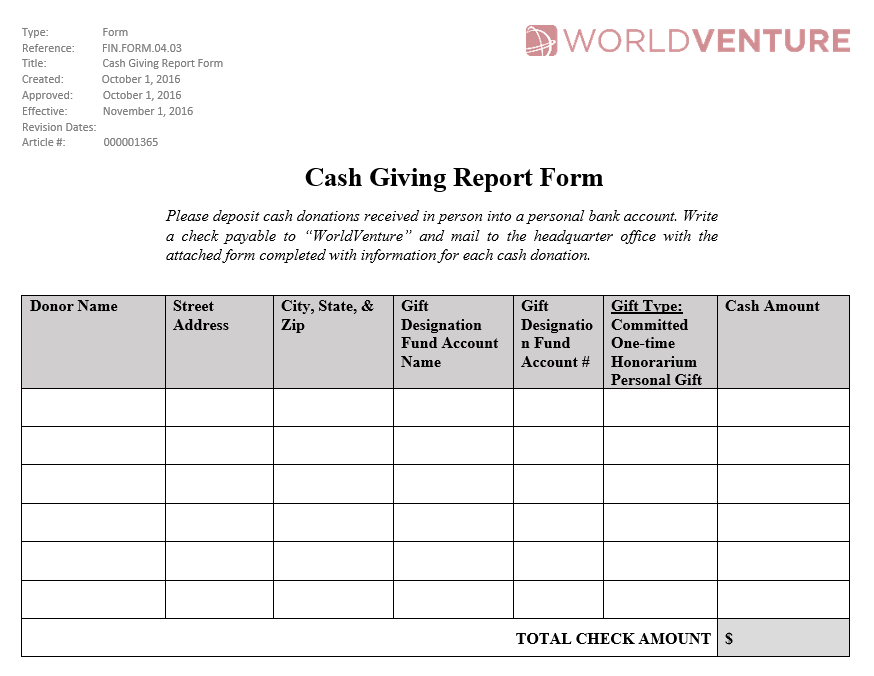
Have you ever spoken at a church or small group and someone hands you some cash as an honorarium? They may phrase it as “to help with your travel costs.” Or maybe you’re visiting a church and someone hands you a hundred dollars in cash to support your ministry? What to do with it? You need to deposit it into your USF and credit them for the donation, but how? (Note that this does not apply to any cash given to you as a personal gift.)
That’s what WorldVenture’s Cash Giving Form is for. You can download this form from the GMC. Just type “cash giving form” into the search bar on the Knowledge tab, and it will be the top item in the results list (its name begins with FIN.FORM.04.03). Click on the blue link to access the form.
You can either print out the empty form and fill it out by hand, or use the electronic version and type all the information into the Word doc and then print it out. In any case, once you have all the information entered into the form and have printed out a hardcopy, write a check from your personal checking account for the total amount of the cash donated to you. Make your check out to “WorldVenture” and add your USF account # to the memo line (or on a separate note). Deposit the cash into your checking account, to cover the check you’ve written to WorldVenture for that amount. Put both the check and the completed cash giving form in an envelope together and snail mail that to WorldVenture, using “Attn: Receipting” as the recipient.
The information on the form allows WorldVenture to credit the appropriate individual or church for their cash donation. Your check will be processed and the amount deposited into your USF as support for ministry expenses.
If you’ve never done this before, it might be good idea to take a look at the form so that you’ll know what information you need to know about your cash donor before that person slips away and you don’t know how to contact them! Here’s what the form looks like:
Some of you have wondered why you’re being asked for what seems like more documentation than ever before with your reimbursement requests (aka expense reports). The truth is that neither WorldVenture policy nor IRS requirements have changed. However, our Financial Services department is safeguarding us from potential issues in the unlikely event of an IRS audit through more rigorous enforcement of long-standing procedures[i] (not to mention helping us maintain an “above reproach” standing in financial integrity, transparency, and stewardship matters).
So what exactly are the requirements for documenting reimbursement requests? It’s pretty straightforward. Here is what is always needed to account for a ministry expense:
Now we know that this will raise problems or concerns in some cases, so let’s go over the legitimate exceptions for each one…
For #2, we know that there are contexts in which getting someone’s name is either culturally inappropriate or could even be potentially dangerous to that individual in a security-compromised location. In such cases, aliases are acceptable. You may use the same level of caution that you use when referring to local individuals in your ministry blogs or newsletters. If you’re concerned about revealing someone’s true name, use an alias.
For #4, some have asked what this means. The “business purpose” of an expense simply refers to why this expense furthers your “business”—i.e., your ministry. In other words, how is this expense advancing your ministry, accomplishing your ministry goals, or funding the operations of running the ministry? Don’t overthink this. For instance, if you’re having coffee with someone you’re discipling, and the purpose of that time was part of your discipleship or training of that person, that’s the “business purpose”: discipleship. And you can always include additional details when describing your “business purpose” on the expense report.
Finally, we come to the sticky issue of receipts (#5). Again, we recognize that in many contexts overseas, receipts are not as routine as in the US. Sometimes you cannot get any receipt at all, or asking for one is culturally offensive. In other situations, you may be able to get some kind of “receipt,” but important pieces of information are missing, such as the vendor’s name, or your own name, or an accurate description of the expense. We simply ask that you do best you can. If you truly cannot obtain a receipt for an expense of $75 or more, write out your own “receipt” that provides the information we need and sign and date it yourself. If your vendor provides a receipt but it doesn’t have all the information desired, add that data to the receipt yourself.
We understand that it can be challenging to get all this documentation, especially in some locations around the world. We simply ask that you do the best you can, and in cases where required documentation is not available or feasible in your context, please supplement the existing documentation with your own information so as to safeguard our organization from violating US rules (such as those from the IRS or the ECFA), and keep us above reproach standing in financial integrity and transparency.
[i] These long-standing policies and procedures are fully delineated in the following documents available on the Knowledge tab of the GMC:
In the non-profit world—like it or not, that’s the world you live in—there’s this thing called “functional expense reporting.” I know, it may sound very finance-ese, and not very interesting, but whether you realize it or not, you ARE interested because it’s something you do frequently, and you need to do it well. Not only do you need to do it well, you want to do it well because doing it well has numerous benefits:
Hopefully that provides enough motivation, so now let’s define what functional expense reporting is and what it means for you.
So what is “functional expense reporting”? It simply means categorizing expenses according to their basic function, or to put it another way, classifying spending based on the purpose for which the costs are incurred. The point of this method of reporting is to demonstrate accurately to our leadership, donors, auditors, and the IRS how donated funds were used. This is essential for transparency and accountability. Here are the three categories (or “functions”) of a non-profit’s expenses:
Reporting based on these categories is not simply “best practice.” Non-profits are required to show how all our spending falls into these three functions. But we would want to do it anyway, because not only will it ensure that we maintain our tax-exempt status, this type of accurate and honest reporting is the only way to preserve the trust of the financial partners who keep our doors open and the gospel flowing to the unreached.
It hardly needs to be said that percentages of expenses by these functional categories can be a key metric for both existing and potential donors. Donors want to see that a high percentage of their dollars are going directly to programs that accomplish the mission of the organization, but they also need to be assured that the basic organizational support structures are being adequately maintained and serviced.
So where do you come in? Most of WorldVenture’s expenses for “program services” are incurred by you, our Global Workers. Thus, we are dependent upon your reporting of your ministry expenses to fulfill this major category of our functional expenses reporting. The more accurate and detailed you are in your expense reporting, the better our general reports are to our donors and auditors.
But that’s not all. Global Worker activity also makes up a significant portion of WorldVenture’s “fundraising” expenses through your partner development efforts. As you can see, these are two separate “functional” categories. As a result, we need to be accurate in reporting your “fundraising” expenses versus your “program services” expenses.
And to make matters worse—or at least a bit more complicated—some of your activities may overlap these two categories. For instance, when you send out a newsletter or write in your ministry blog, are you “fundraising” or providing “program services”? Well, maybe a little of both!
You may remember that a year or two ago, we sent out a survey asking you to estimate the percentage of your work time that is spent on fundraising efforts. The results of that survey were a great help in allowing us to more accurately categorize our expenses in these two categories. However, we will continue to need your help as we categorize our expenses – even those that overlap between two functional categories. Toward the end of this year, you will receive another survey that will enhance our accuracy in this “functional expense reporting” responsibility. Keep an eye out for that, and please participate in the survey when it comes out. You have our thanks in advance.
Information contained in this newsletter is intended for internal use by WorldVenture workers, staff, approved volunteers, and board members. Unauthorized distribution to other parties is not permitted without permission from Finance leadership.